
Life in Kalaat Sraghna (The Five Themes of Geography)

There’s a town in central Morocco that doesn’t show up in travel magazines or glossy documentaries, but it shaped everything about who I am. Kalaat Sraghna sits quietly between Marrakesh and Beni Mellal, and if you drove past it without knowing, you might think it’s just another stop on the road. But to the people who grew up there — people like me — it’s a whole world of its own. And through my memories, you can see exactly how the Five Themes of Geography play out in real life.
1. Location — A Crossroads With a Big Heart
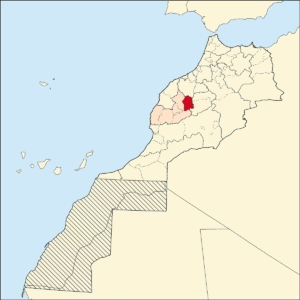
Kalaat Sraghna sits quietly in the heart of El Kelaâ des Sraghna Province, nestled between two major Moroccan cities — Marrakesh and Beni Mellal. It’s more than a geographic midpoint; it’s a place where roads converge and people connect. Travelers pass through often, but they rarely pass unnoticed.
Here, hospitality isn’t a gesture — it’s a rhythm. You might be offered tea, a meal, or a bag of olives before you’ve even introduced yourself. That warmth is stitched into daily life, just as much as the olive groves that stretch toward the horizon or the red earth beneath your feet. Kalaat Sraghna may not announce itself loudly, but its welcome is unforgettable. It’s not just where it is on the map — it’s what it offers to those who land there, even briefly: a pause, a smile, and a sense that you’ve arrived somewhere that matters.
2. Place — The Look, the Feel, and the Small Details That Stay With You
If you ever come to my town, the first thing you’ll feel is the air — clean, open, almost untouched. With hardly any factories, the sky looks wider, and breathing feels easier. All around us, the land is surrounded by villages woven together through one thing: the olive tree. Here, olives aren’t just something we grow; they shape our culture, our work, and our daily rhythm.
And then comes Monday Market, the heartbeat of the week. Vendors flood in from every direction, bringing everything from farm produce to handcrafted goods. One corner is completely dedicated to olives — every variety, every flavor, and the rich oils our region is known for. People come to stock up for the whole week: meat, vegetables, fruit, spices, house essentials — you name it. The market is loud, colorful, a little chaotic… but completely alive in the most Moroccan way.
Beyond the noise, there’s the softness of memory. I think of being a young girl going with Souad to her home — the smell of mint tea drifting from her kitchen, her son eager to play, neighbors greeting each other like family. That’s the real geography of a place: not just the land or the trees, but the small moments that stay with you long after you’ve walked away.Beyond the noise, there’s the softness of memory. I think of being a young girl going with Souad to her home — the smell of mint tea drifting from her kitchen, her son eager to play, neighbors greeting each other like family. That’s the real geography of a place: not just the land or the trees, but the small moments that stay with you long after you’ve walked away.
3. Human–Environment Interaction — Living With What the Land Gives Us
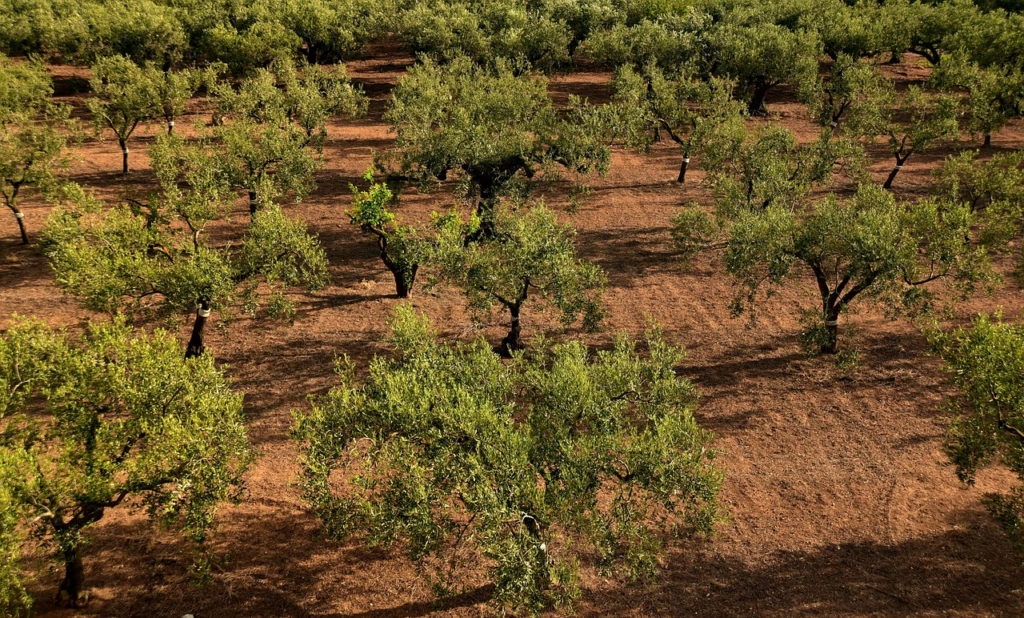
Where I’m from, people don’t just live near the environment — they live with it. The climate is mild, the air is healing. Doctors sometimes tell asthma or allergy patients to spend time in my hometown because the air is so pure. Imagine being proud of your town’s atmosphere. I kind of am.
And olives? They’re the center of everything. We grow them, harvest them, press them, cook with them, argue about them, gift them. The land gives us olives, and we’ve built an entire way of life around them.
4. Movement — How We Move, and Who Comes Through
Transportation in Kalaat Sraghna is simple: cars, buses, and taxis. No metro, no trains — we keep it old-school. But don’t let that fool you into thinking the town is isolated. People are always on the move, and the flow in and out of town never really stops.
Relatives arrive for the weekend, carrying bags of fruit, gossip, and warmth. Traders pull up with goods — spices, fabrics, electronics — ready to negotiate in the market stalls. Workers commute between nearby cities, hopping in and out of taxis or buses as part of their daily routine. And then there are the travelers who promise they’re “just stopping for tea,” but end up staying for lunch, dinner, and maybe even the night.
Every movement brings something new — stories, energy, or just the comfort of familiar faces. If you sit at a café near the main road long enough, you’ll see it all: a steady stream of people coming and going, each with their own reason, their own rhythm. Movement, here, is constant — and it connects us all.
5. Region — The Bigger Identity We Share
Our region is more than lines on a map — it’s a rhythm of life that links Kalaat Sraghna to the surrounding towns, fields, and hills. Here, people don’t just know each other — they show up for each other. Weddings last for days, filled with drums, laughter, and guests from far and wide. Holidays overflow with noise and flavor: cousins shouting over trays of cookies, tagines bubbling on stovetops, grandparents holding court in the living room. Even when life pulls us toward city jobs or distant schools, we return to visit, reconnect, and remind each other who we are.
This connection across space — through customs, gatherings, and shared memory — is what makes our region feel whole. It’s in the way people greet one another with warmth, in the echo of the call to prayer across rooftops, in the steady flow of relatives, food, and stories from one household to another. This isn’t just a cluster of towns. It’s a cultural identity we carry with us — felt deeply, lived daily, and shared across generations.
Why My Story Matters for Geography
The Five Themes of Geography aren’t just terms to memorize. They’re a way to understand how people live. When you look at my hometown — its location between cities, its olive fields, its clean air, the flow of visitors, and the traditions that stretch across the region — you see how geography shapes culture, and how culture shapes the meaning of a place.
Kalaat Sraghna might not be on your bucket list, but it’s the lens through which I understand the world. And if my story helps you see how geography comes alive through real people, then it’s worth sharing.