Topic 3.4 – Language and Communication

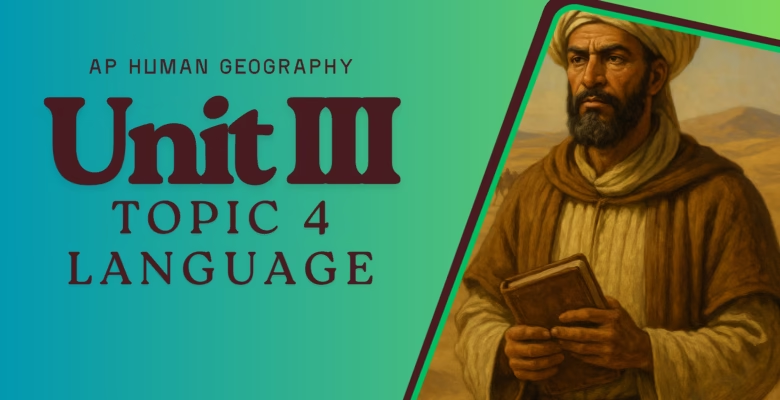
“Traveling – it leaves you speechless, then turns you into a storyteller.”
— Ibn Battuta
Language: More Than Just Words
Language. It’s how we order coffee, text our besties, argue about pineapple on pizza, and write love letters (or passive-aggressive emails). But in Human Geography, language is way more than talking — it’s a cultural superpower that shapes identity, spreads across continents, causes conflict, builds unity, and literally determines how we see the world.
This topic is big. It’s everywhere. And yes, it’s definitely on the AP Exam — so let’s lock in.
1. Language Is Culture’s MVP
At its core, language is one of the strongest cultural traits a group of people can have. It’s how ideas are shared, traditions are passed down, and how culture stays alive across generations. Without language, there’s no storytelling, no religion, no memes, and no AP Human Geo class (tragic, honestly).
In AP terms, language is a key part of cultural identity — and that makes it a centripetal force, helping to unite people. But if multiple language groups are fighting for dominance? Boom. Now it’s a centrifugal force, pulling groups apart and causing tension. Think Belgium (Dutch vs. French), Canada (English vs. French), or even the U.S. (English only vs. multilingual policies).
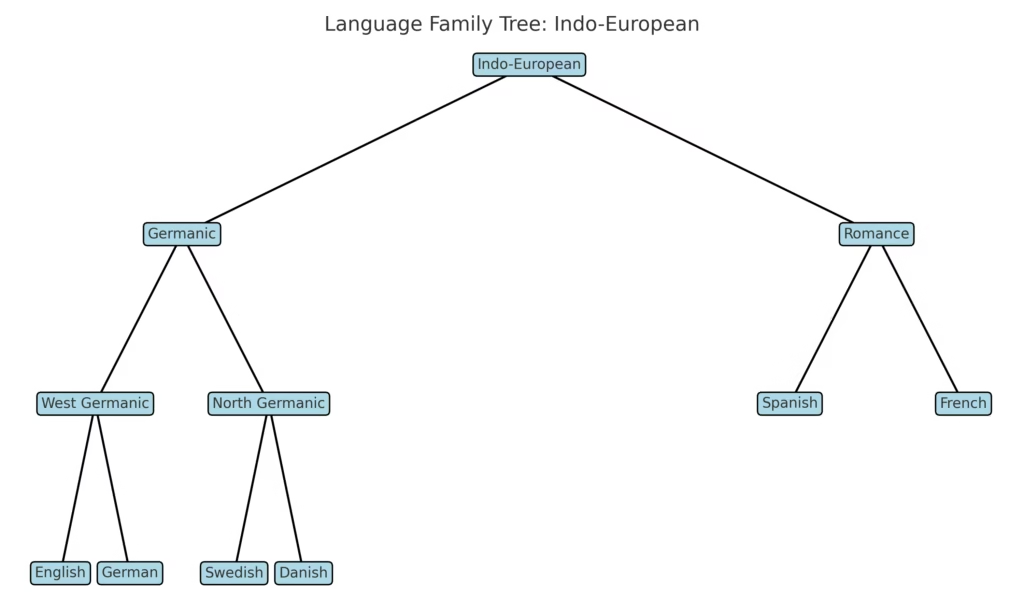
2. Language Families, Branches, and Groups (It’s a Family Tree, Not a Family Feud)
Languages don’t just pop up out of nowhere. They evolve. And just like your weird cousin twice removed, every language has roots.
- A language family is the oldest and widest group (ex: Indo-European, spoken by nearly half the world).
- A language branch is a smaller division within a family (ex: Romance languages like Spanish and French).
- A language group is super close — almost like siblings (ex: West Germanic = English and German).
So when we say English, Spanish, Russian, and Hindi are all part of the same family (Indo-European), we’re not being cute — we’re being accurate.
3. The Diffusion of Language: Words on the Move
Languages don’t stay still. They travel — with people, power, and sometimes with pizza.
- Relocation Diffusion happens when people physically move and bring their language with them. This is how Spanish spread across Latin America.
- Expansion Diffusion happens when language spreads but the speakers stay put. This includes:
- Hierarchical Diffusion: From the top down — think colonizers, government, or celebrities. If Beyoncé started speaking Swedish, you bet it would catch on.
- Contagious Diffusion: Rapid, widespread — like slang on TikTok or English through pop culture.
- Stimulus Diffusion: The idea spreads, but it’s modified. Think of McDonald’s in India: same concept, but with masala burgers instead of Big Macs.
Colonialism, trade, war, migration, globalization, and even Netflix — they’ve all played a role in pushing language across the globe.
4. Lingua Franca, Pidgins, and Creoles: How People Make Language Work
Let’s be real: when people from different language backgrounds need to communicate, they get creative.
- A lingua franca is a “go-between” language used for trade or communication. Today, English is the global lingua franca — it’s used in business, science, air traffic control, and memes.
- A pidgin is a simplified mashup of two or more languages. It has no native speakers, but it gets the job done — like when colonizers and local populations had to communicate.
- A creole forms when a pidgin becomes a native language, often passed down generationally. Haitian Creole is a classic example.
It’s linguistic evolution in real time — and it shows how flexible and funky language can be.
5. Standard, Official, and Institutional Languages: The Rules of the Game
Not all languages are treated equally. Some get polished up and put on a pedestal.
- A standard language is the “proper” version taught in schools, used in media, and accepted in formal writing (hello, MLA format).
- An official language is declared by the government — it’s used in laws, court, and public signage. Some countries have one; others (like South Africa) have 11.
- An institutional language is used in education, media, business, and government — it has societal structure behind it.
These labels come with power. When one language becomes “official,” others can get pushed aside, which leads us to…
6. Endangered and Revived Languages: Use It or Lose It
Languages die. About half of the world’s 7,000+ languages are at risk of disappearing in the next century. That’s a cultural tragedy.
Why does this happen?
- Globalization (English dominates)
- Colonization (local languages replaced)
- Migration (you don’t pass on a language if no one speaks it around you)
- Lack of institutional support (no schools, no signs, no love)
But some languages are being revived through education, tech, and cultural pride. Hebrew was brought back from ancient scripture to a living language. Welsh and Maori have seen massive comebacks. Even apps like Duolingo are helping with the revival game.
Final Thoughts: Why It All Matters
This topic isn’t just vocab. It’s about how language reflects power, culture, and identity. Knowing the difference between a lingua franca and a creole isn’t just for test points — it’s for understanding how people connect across space and time.
So take good notes. Ask questions. Be curious. Because mastering this section isn’t just about scoring that first college credit (though yes — that’s happening). It’s about seeing the world in a whole new way.
And remember: language changes the world… and you’re learning how it happens.
🎥 Crash Course Video: How Does Language Move?
Alright, you’ve made it through the meaty part of this topic — now it’s time to see it all in action.
This Crash Course video dives into how languages travel across the world: through conquest, trade, migration, memes, and more. It covers the big diffusion concepts (relocation, expansion, contagious, hierarchical, stimulus) with fast visuals, real-world examples, and that signature Crash Course energy.
Watch closely for vocab you’ve already seen: lingua franca, creole, pidgin, and all those forces that push language around like luggage on a global carousel. It’s basically everything we just broke down — but animated.
Hit play, soak it in, and then scroll into the Essential Questions like the AP Human Geo pro you’re becoming.
Essential Questions
Language is more than just words — it’s power, identity, and connection. In this section, you’ll dig into the big questions behind how languages spread, change, dominate, and sometimes disappear. These questions aren’t just here to test what you remember — they’re designed to push you to think critically about how language shapes the world around us. Use what you’ve learned, draw from real-world examples, and don’t be afraid to make connections. The stronger your understanding here, the stronger you’ll be when it’s time to face the AP exam (and flex those college-ready skills). Let’s dive in.
✅ Essential Question 1: How do languages spread and change over time?
Approach:
- Begin with how languages are tied to culture and identity.
- Explain relocation diffusion (people migrate and bring language) and expansion diffusion (language spreads via media, power, or contact without migration).
- Mention colonialism as a major force in global language spread (ex: Spanish in Latin America, French in West Africa).
- Include globalization and technology — the internet, music, and pop culture all contribute to language mixing, slang adoption, and widespread understanding.
- Wrap it up by emphasizing that as languages move, they evolve: new dialects, creoles, pidgins, and even revived languages can form.
✅ Essential Question 2: Why is English the dominant global language?
Approach:
- Start with the concept of a lingua franca and explain why English fits that role globally.
- Highlight historical reasons: British colonialism planted English across continents.
- Connect to the modern era: U.S. global influence post-WWII through media, economics, science, and tech (Hollywood, internet, global brands).
- Show how English is reinforced daily: taught in schools, used in business, navigation, and pop culture.
- Students might discuss both positives (easier communication) and negatives (cultural erasure, language loss).
✅ Essential Question 3: Why do some languages disappear while others survive?
Approach:
- Define endangered languages and explain common causes: colonization, lack of institutional support, assimilation, migration, and globalization.
- Include real-world examples (e.g., Indigenous languages in North America, Welsh revival).
- Discuss how some governments promote official or standard languages, sometimes at the expense of others.
- Bring in the idea of language preservation: education, media, policy changes, and cultural pride movements.
- Emphasize how language is deeply tied to cultural identity — when a language dies, a unique worldview often dies with it.
Tips for All Questions:
Use vocabulary from class to flex your knowledge.
Include real-world examples — those get you FRQ points and make your answer stronger.
Think critically: It’s not just what happened, but why it matters and who it affects.